
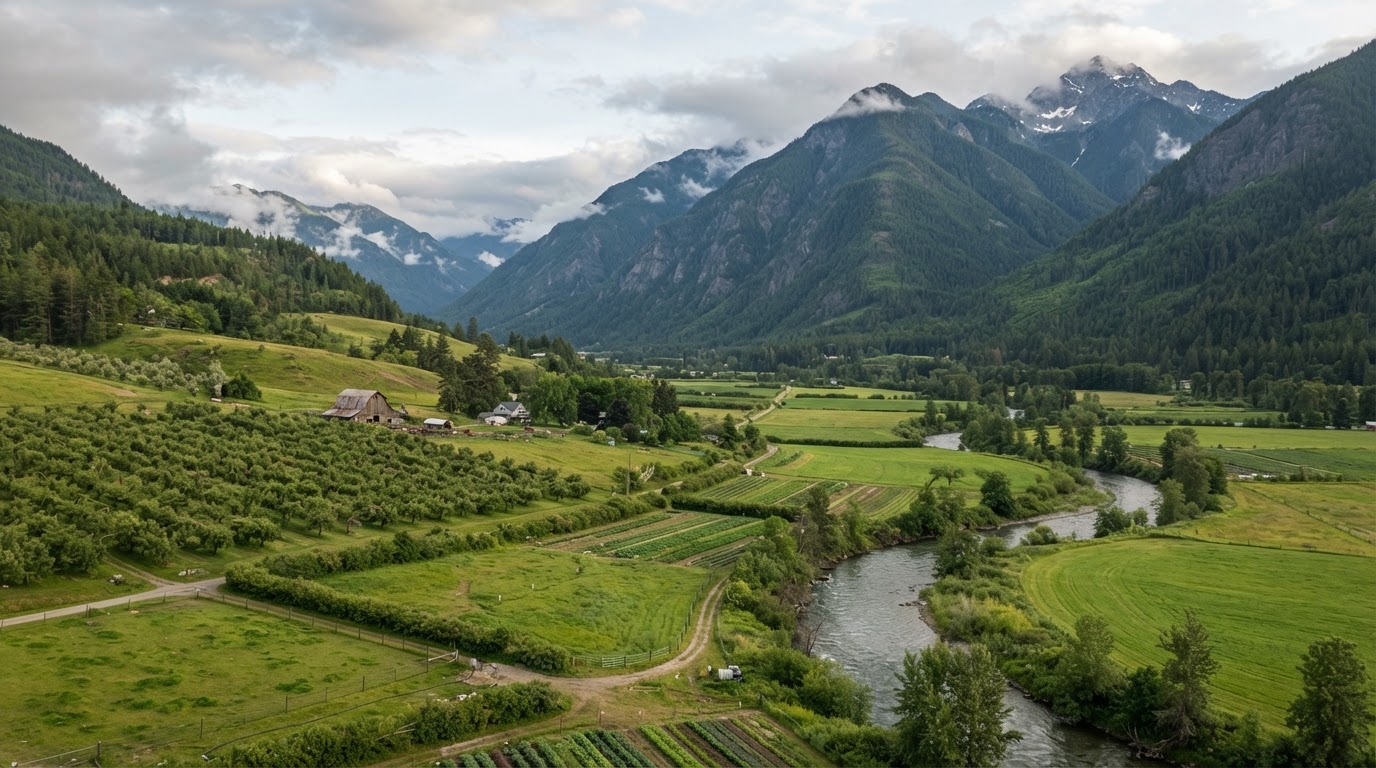
Orchards for Sale in the Kootenay Boundary
The Kootenay Boundary supports smaller-scale orchards in sheltered valleys — tree fruit around Creston and Grand Forks, where microclimate and valley-floor soils create pockets of productivity. These orchards operate at a different scale and terroir than the Okanagan.
Why Kootenay Boundary
Orchards & Tree Fruit in Kootenay Boundary
Warm, sheltered valleys in the Kootenay Boundary — particularly around Creston and Grand Forks — have microclimates that can support tree fruit. The region's orchards are smaller and more locally oriented than the Okanagan's, but the valley-floor soils, mountain hydrology and distinct microclimates offer genuine tree-fruit potential outside the mainstream fruit regions.
What to Know Before Buying
Kootenay orchards depend on microclimate in a way the Okanagan does not. Suitability varies sharply by elevation, aspect and frost pocket, and a productive site in one valley may not translate to another. Verify the specific parcel's microclimate, frost risk and growing-season length before buying — the mountainous terrain makes site selection the single most important factor.
Mountain hydrology means water availability varies sharply by valley and elevation. Tree fruit needs irrigation, and a Kootenay orchard's water source may be a mountain stream, a well or a regional system. Verify water licences under the Water Sustainability Act, well records and any irrigation-district allocation — the reliability and licensing of the water source is central to the orchard's viability.
Kootenay orchards are typically smaller-scale and locally oriented, often combining fruit with direct sales, farm-gate markets or value-added products. The packing, storage and distribution infrastructure is less developed than the Okanagan's. Understand the operation's sales model and what transfers — including any packing equipment, cool storage or marketing arrangements.
Due Diligence Checklist
- Assess the specific parcel's microclimate, frost risk and growing-season length.
- Verify water licences, well records and any irrigation-district allocation.
- Review valley-floor soil capability, drainage and aspect.
- Assess tree age, variety mix, vigour and the replanting timeline.
- Confirm ALR status and regional-district zoning for direct-sales or value-added activity.
- Clarify whether packing, storage or marketing arrangements transfer.
What Drives Value
Illustrative guidance only — actual value depends on the specific parcel, its condition, water, soil and current market. Not a formal valuation.
Frequently Asked Questions
Can the Kootenays support orchards?
Some warm, sheltered valleys — particularly around Creston and Grand Forks — have microclimates that can support tree fruit, but suitability varies sharply by elevation, aspect and frost pocket. Verify the specific parcel's microclimate, water and frost risk before buying with orchard expectations.
How do Kootenay orchards differ from Okanagan orchards?
Kootenay orchards are typically smaller-scale and locally oriented, with less developed packing and distribution infrastructure. They depend more heavily on microclimate, and the terroir is genuinely different. The scale, water profile and sales model all differ from Okanagan operations.
Is water reliable for a Kootenay orchard?
Mountain hydrology means water availability varies sharply by valley and elevation. A Kootenay orchard's water source may be a mountain stream, a well or a regional system. Verify water licences, well records and irrigation allocation — the source and its reliability are central to viability.
Where in the Kootenay Boundary are orchards found?
Kootenay orchards are concentrated around Creston and Grand Forks, where sheltered valley microclimates and valley-floor soils can support tree fruit. The region is smaller and less established than the Okanagan.
Related Resources
Other Farm Types in Kootenay Boundary
Orchards & Tree Fruit in Other BC Regions
Looking for orchards & tree fruit in Kootenay Boundary?
From Kootenay Boundary orchards & tree fruit to other BC farm types, get expert guidance from a real estate professional who specializes in British Columbia agricultural land.